Choose address terms by character relationship when translating Chinese novels
Tri Thu知秋
· Updated
On this page
There is a novel that goes like this: the master calls himself "I" and addresses his disciple as "you" for four hundred chapters. The prose flows, but the relationship is dead from chapter one. Its most memorable scene is not a battle. It is the moment the master calls the disciple up the mountain, intending to hand down every sword art of his life. The line in the original:

为师今日便传你这套剑法
A flat translation might read:
I will teach you this sword technique.
It reads smoothly. Every word correct, the meaning intact. And it sounds like a coworker sending over a file, not a master handing down what he has kept his whole life to the only disciple he has.
The error sits in the addressing. 为师 is how a master speaks of himself: this teacher, but the translation wrote it as "I". 你, in the mouth of a superior addressing someone below him, could be carried over with the rank left standing; here it came out as plain "you". The sentence stays easy to understand, but that way of addressing flattens the relationship the whole novel builds through its dialogue.
The line right after that, the disciple kneels and answers:
弟子定不负师父所传
A flat translation might read:
I won't let you down.
Two lines back to back from one master-and-disciple pair. In the first, the master speaks and the disciple listens; here the disciple answers. 为师 is the master's way of naming himself, 师父 is how the disciple calls the master, and 弟子 is how the disciple names himself. In this example the translation hands "I" and "you" to both people, so the relationship between master and disciple no longer comes through. That is why my address table has to record both directions: how the master calls the disciple, and how the disciple calls the master. When I reread the dialogue, I check each direction against that table.
The word going up and the word coming down are two different words
Readers of Chinese novels already know the registers: shifu, senior brother, this old man, this seat. The single characters are not hard: 我 can be "I", 你 can be "you". Inside a line of dialogue, one more question has to be asked: who is speaking, and who is the other person? In a novel built on rank, the way the master addresses down to the disciple is not the way the disciple answers up to the master.
Master and disciple. The disciple calls himself "this disciple" and says "Master". The master calls himself "this master" and speaks down with "you". Hand both sides "I" and "you" and master and disciple come out as equals.
Senior brother and junior brother. The junior calls himself "junior brother" and says "Senior Brother". The senior calls himself "senior brother" and says "dear junior" back. Give both sides "bro" and "you" and nobody can tell who is elder, who is younger, and the image of the junior standing behind, calling out "Senior Brother", is gone. How senior and junior brothers and sisters of the same sect address each other has its own article: Senior brother, senior sister, junior brother and junior sister in xianxia.
Emperor and minister. The emperor calls himself "We" and calls the minister "my dear official". The minister calls himself "this subject" and says "Your Majesty". A translation that hands both of them "I" and "you" erases the throne itself, the thing the novel spent a hundred chapters raising up. The pairs above follow the roles the story hands out; kinship inside a clan, the uncles and the cousins, is the deeper layer of this same axis, and I treat it separately in Chinese family terms in novel translation: telling the uncles and cousins apart.
The strange part: a translation like that is still readable. You wince once and keep going, because the next sentence still makes sense. And that is exactly why the error survives a hundred chapters. Nobody bothers to stop.
The table I lock before translating, one row per pair
No need for ten pairs. Each novel only gets the pairs it actually has. My table for that novel had three rows:
| Pair | Lower side: self-address, calls | Upper side: self-address, calls | My call |
|---|---|---|---|
| Master, disciple | self "this disciple", calls "Master" | self "this master", speaks down with "you" | keep "this master", never flatten to "I" |
| Senior brother, junior brother | self "junior brother", calls "Senior Brother" | self "senior brother", calls "dear junior" | keep "Senior Brother", don't drop it to just the name |
| Emperor, minister | self "this subject", calls "Your Majesty" | self "We", calls "my dear official" | keep "We" and "Your Majesty", don't flatten to "I" and "you" |
The last column is the actual work. Keeping "this master" or flattening it to "I", keeping "Your Majesty" or settling for "you", is a decision I make myself, following the relationship between the characters. Lock it once for the whole novel, then reread the later dialogue against it.
The first ten chapters, I only read to collect people
I don't translate the moment I open the file. The first ten chapters are reading only, and the single job is collecting pairs: whichever two characters have a way of addressing each other gets one row. After ten chapters I have a page with a few lines on it, and from then on, every line of dialogue gets read against that page.
Lock it right then, don't put it off. The same 你 can come out as "you" in one passage, as a name in the next, as some other flat word the round after that. If you have not chosen the addressing for each pair of characters, then when you reread the dialogue you will hardly know which spots to keep and which to fix.
The single-word part is lighter, but it isn't the whole job. NovelVerba ships genre packs ready-made: turn on the Xianxia pack for a cultivation novel and terms like 师父, 师兄, 道友, 前辈 come pre-suggested as master, senior brother, Fellow Daoist, senior, fed into the translation pass so the AI has something to pick from. The pack toggles on and off, the novel's own dictionary still wins, and the AI still misses now and then, so I re-check it the same way I re-check self-address. A dictionary suggests words. It cannot lock a direction. Who calls whom what in your novel, it does not know. The interface has no separate field for a relationship table yet either, so I keep my sheet of paper next to the screen and hold every line of dialogue against it. For genre-specific term tables, see Xianxia cultivation realms and terms in translation: from Qi Refining to Tribulation Crossing without literal traps, Xuanhuan and western fantasy terms in translation: Dou Qi ranks, technique tiers, and magic classes, System and LitRPG web novel terms in translation: status screens, dungeons, quests, and cheats, Chinese urban novel terms in translation: showbiz, antique appraisal, and business, Chinese palace terms in translation: consort ranks, princely titles, and forms of address, What 嫡女 means, and why wives and concubines rank differently in Chinese novels, Wuxia and Murim terms in translation: internal energy, sword qi, sword aura, and sect names, Isekai light novel terms in translation: reincarnation, transfer, the Adventurer's Guild, and magic, Villainess novel terms in translation: noble ranks, engagement annulment, Condemnation Event, Danmei, GL and Omegaverse terms in Chinese novel translation: tops, bottoms, pheromones, Kunze, Mafia, dark romance and werewolf terms in Chinese novel translation: Godfather, Luna, Vampire Clan, Chinese apocalypse, sci-fi and horror novel terms: zombies, crystal cores, rule horror, and Chinese romance novel slang in translation: avoiding literal traps like eating vinegar and green hat.
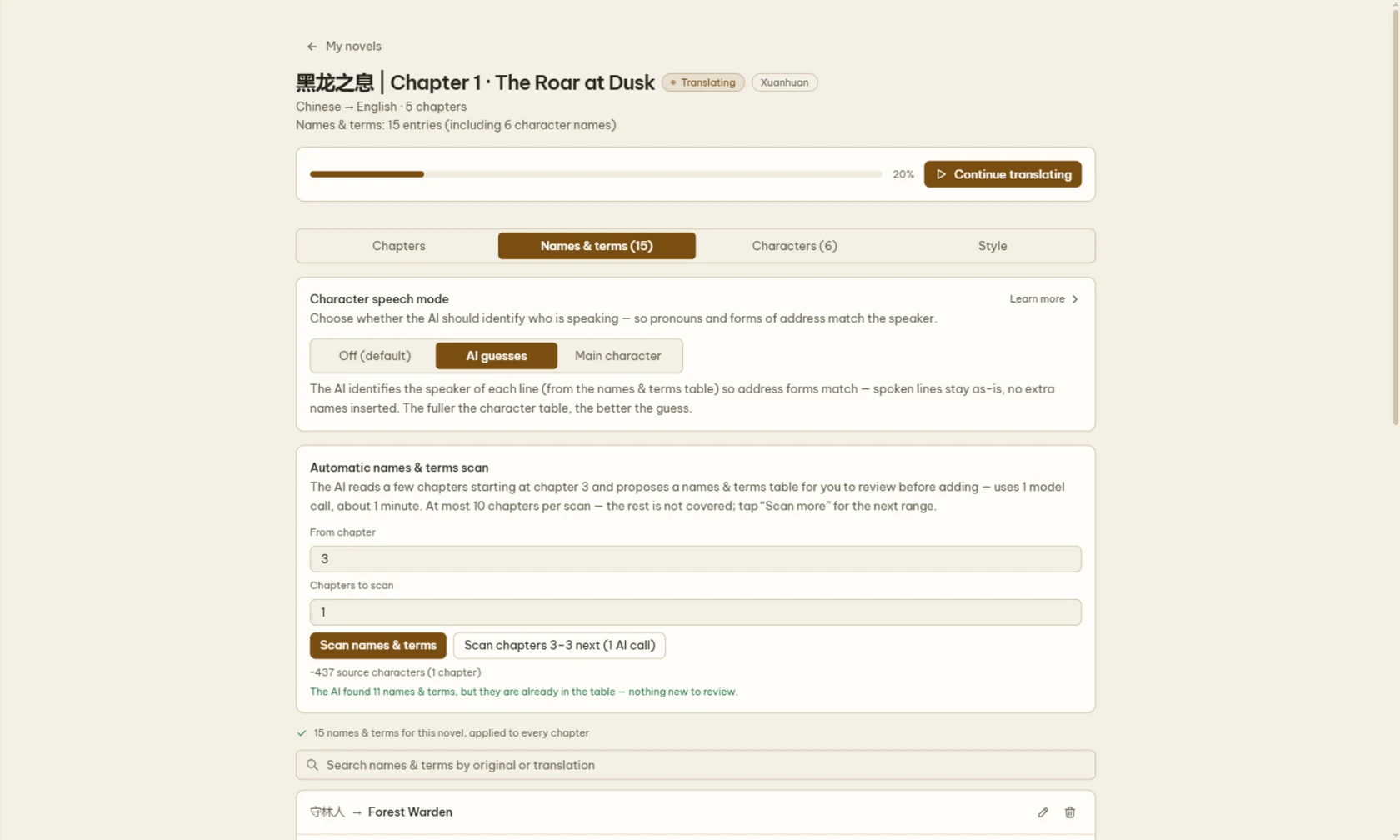
Before I hit translate on a batch, I also switch on "Addressing by character", right there on the novel's page. It does not replace the paper. It only tells the AI to guess who is speaking, line by line, based on the novel's name table, so each line of dialogue attaches to the right speaker. It does not insert names into the dialogue, and the fuller the name table, the better it guesses. Whether the name table is full or thin is the business of the names article.
After each batch, I re-check the dialogue through three eyes before translating on.
- Does the lower side's address going up match the word on my paper.
- Has the upper side's address coming down been softened.
- Has a self-address been flattened into plain "I".
Wherever it drifted, I fix that spot. The next batch starts from the locked table, not from wherever things went wrong.
Two places the sheet of paper cannot save you
One person, two roles. His teacher, who later becomes his enemy. The way the two of them speak shifts by stage, deferential in one stretch, spitting in the next, and one row on a sheet of paper cannot hold both eras at once. I lock an extra row for the later stage, and I treat the transition stretch as a stretch to be read slowly.
Honorifics used to sneer. A character respectfully says "senior", while inside he is mocking him. Translating it word-faithful drops the knife out of the sentence. The AI sometimes reads it right, sometimes misses the barb, especially when the line is short on context, so I don't count on it. I read the dialogue out loud, and wherever it clunks, I fix it by hand.
The addressing sheet handles who calls whom what. One person with several ways of being called, nicknames like "Old Monster" and "brat" that make the translation look like fresh characters have walked in, that is name-table business, and I cover it in the article on keeping character names consistent; the 7-step rule for choosing between pinyin and translated meaning is in Character and place names in novel translation: when to keep pinyin and when to translate the meaning, and keeping book and chapter titles aligned with the table of contents is covered in Translating web novel book and chapter titles: keeping names aligned with the table of contents. If you want to see one novel the whole way through, from source file to translation, the complete process lives in the overview article.
This article uses examples from Chinese novels. For Korean novels, the choice among oppa, eonni, hyeong and nuna also weighs the speaker's gender; I cover that system separately in the article on Korean honorifics alongside Korean web novel terms in translation: Hunters, Dungeons, Constellations, and Regression, while Japanese suffix honorifics and first-person pronouns are covered in Japanese honorifics and pronouns in Light Novels: -san, senpai, Ore, and Boku.
I do all of the above with the novel I am reading, on my own file, and I start from the NovelVerba web novel translator.