Translating a long novel with AI: from preparing the file to checking the translation
Tri Thu知秋
· Updated
On this page
- Before AI, the same mess happened in the same place
- How I translate a novel now: five things I always do
- 1. Open the file and check it before translating
- 2. Gather main names and nicknames into one table
- 3. Write down forms of address in both directions
- 4. Translate runs short enough that I can still check them
- 5. Until three things are checked, there is no next run
- Three places the name table cannot save you
More than 50 AI-translated novels share one breaking point: the sentences hold up, but one character keeps changing his name and switching how he addresses people halfway through. The mess was never in the sentences. It was in the people.

In chapter 1 the main character is Lin Feng. By chapter 17 the same man is Feng Lin. Halfway through chapter 17 there is still a whole passage sitting in Chinese, because the translation run stopped before a sentence was finished. I read it twice. The first time I thought the novel had added someone new. Only on the second reading did I realize that both names referred to the same character.
The line that stopped me completely was the master's. The source says 为师今日便传你这套剑法. The machine turned it into:
I will teach you this sword technique.
The master became someone standing on the same level as the disciple. In the source he never says "I". He says "this master", 为师. The machine took the title away, left a plain "I", and with one word erased the seat the whole novel had been building.
I never managed to count the exact number, I only know it went past fifty novels. Not one of them taught me a trick. The whole pile taught one thing. The longer the novel, the more the machine forgets the people it met in the early chapters. The main name drifts first. Nicknames follow. Forms of address fall apart last. Translating in one stretch from chapter 1 to the final chapter is the fastest way to get something that reads sentence by sentence, and fails to read as a novel.
The novel that broke me was a xianxia over four hundred chapters. I read it as a converted copy, because there was nothing else. Somewhere around chapter 180 I realized that the man being hunted and the man hunting him were the same person. The machine had written his name two ways, and I had read one man as two for a third of the novel. Nobody was checking that for me.
Before AI, the same mess happened in the same place
Before most of what exists now, I read converted copies. The conversions were free, updated slowly, and the names changed per chapter depending on who had edited. When a novel got too urgent, I finished it myself. The method: paste each paragraph into Google Translate, copy the result into a file, then find and replace.
I replaced "Lin Feng" everywhere and thought I was done. Reading on, I hit "Brother Lin". The find command never touched it, because it was not the phrase I had typed. The same man, two ways to call him, and the find command only knew one. I lost a weekend on a job that only looked unfinished once it was finished.
AI is better at sentences. But I do not expect a single translation run to carry every decision made chapters earlier. If names and forms of address are not fed back into the next run, I count them as never having been locked.
How I translate a novel now: five things I always do
I do not translate the whole file. Each step below ends with something in my hands. Without that thing, I do not move to the next step.
1. Open the file and check it before translating
I open three spots: the head of the file, the middle, the end. If the source text cannot be read, I stop, and I do not wait for the translation to guess for me. TXT and Markdown files get saved as UTF-8. When a chapter title is glued to an ad, or an opening passage is not the story, I split it out first.
When this step is done I have a readable file with the chapters in order. My file that time was broken in the middle, not at the head, so opening only the front showed nothing. Encoding errors, chapters tangled with ads, openings that are not the story, I handle them with the guide to preparing a novel file. For a novel still sitting in a PDF or DOCX, the conversion happens outside the app before this step; I pick which format to convert it to using Translate a novel from a PDF file: which format should you convert it to before uploading? For Korean web novels or Japanese Light Novels with furigana markup and different chapter numbering, see Translating Korean web novels and Japanese Light Novels with AI: files and packs. This is also where I check the three copyright questions to answer before uploading. To estimate how many credits the whole novel will need, and whether a failed chapter costs you anything, see Novel translation cost with AI: what you pay, and do you lose credits if it fails midway?
2. Gather main names and nicknames into one table
I read roughly the first ten chapters without translating. The only job is gathering people. Lin Feng, Feng Lin and Brother Lin in this novel are one person, not three.
| Name in source | Name I use | Other ways it appears | Note |
|---|---|---|---|
| 林峰 | Lin Feng | Brother Lin, Feng Lin | Same person |
| 师父 | Master | Shifu | Check who is speaking, then lock |
When this step is done I have a character table. One row per person. In a novel where one man carries three spellings like Lin Feng does, this table is the hard part, and I wrote it up separately in how to keep character names consistent when translating a novel.
3. Write down forms of address in both directions
A correct name is not enough. Master and disciple address each other one way, and when the machine renders both sides as plain "I" and "you", the relationship is gone. Each pair gets two rows in my table, because the direction there and the direction back are not the same.
| Who speaks | Who listens | Names self | Names the other |
|---|---|---|---|
| Master | Disciple | this master | disciple |
| Disciple | Master | this disciple | Master |
When this step is done I have a relationship table. Without it I do not start translating. The master flattened into a plain "I" above is only one pair. In novels with many pairs, I lock each pair following how to lock forms of address for each pair of characters.
4. Translate runs short enough that I can still check them
I do not hand over the whole novel and watch a line say done. I pick runs short enough that I can re-read all of it before pressing on. For me, the limit of one run is not a pretty chapter count. It is whether I still have the strength left to check it. How I split a long series into those runs so the next session picks up at the right spot and the names still match, I wrote down in Translating a long novel in batches: where the next session picks up, and whether the names still match.
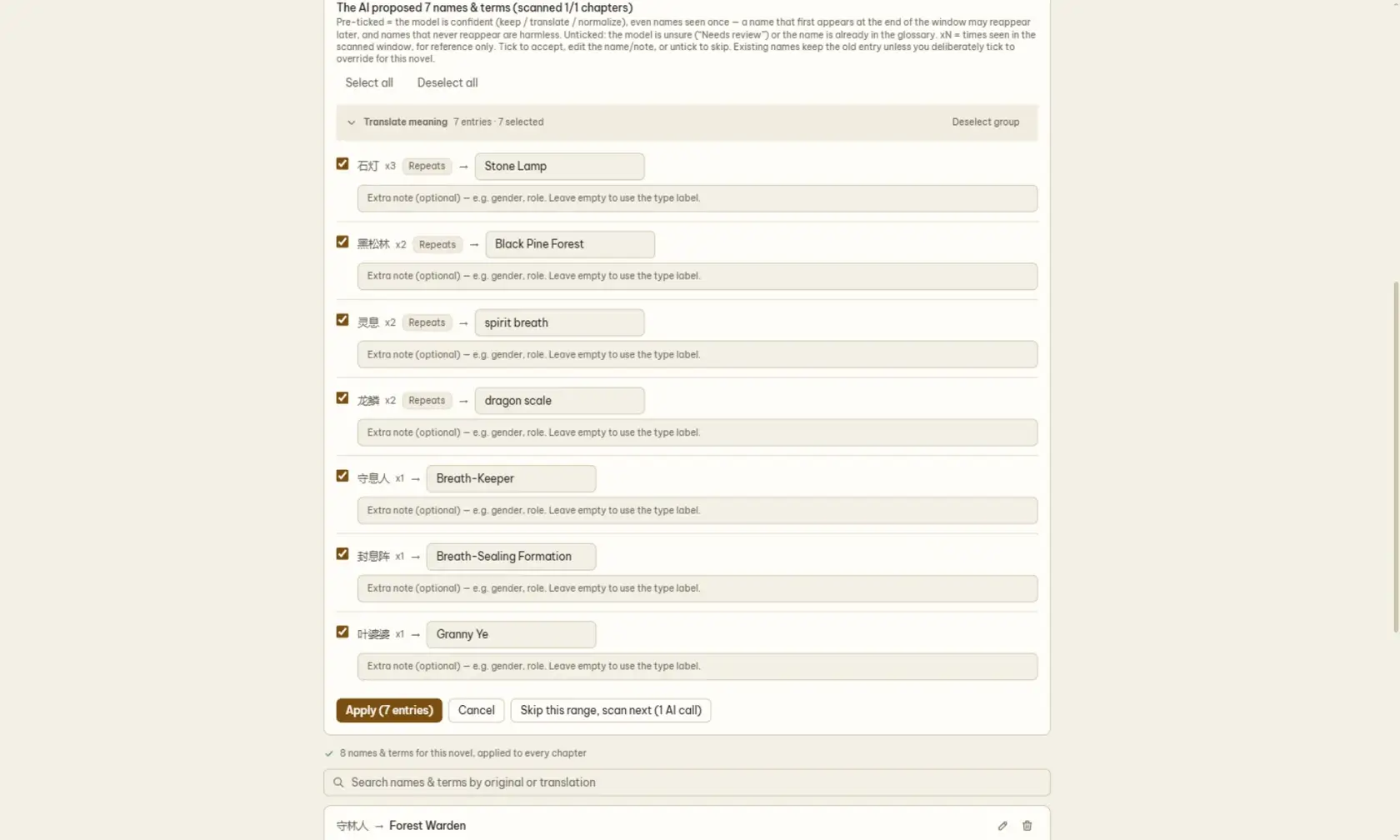
This is where the name table gets used. I feed it into the novel's Names & terms table through the scan: NovelVerba scans names in the chapter range I choose, I review each one, and the approved names travel with every later run, no pasting from scratch each time. The relationship table is a different story: the interface has no dedicated place to enter it, so I do not put it into the machine. I keep it next to the screen and check every run against it. Two tables, two jobs, and they cannot replace each other. The machine has a concrete choice to follow. It does not know on its own that the choice is right.
When this step is done I have one translated run, not one finished novel.
5. Until three things are checked, there is no next run
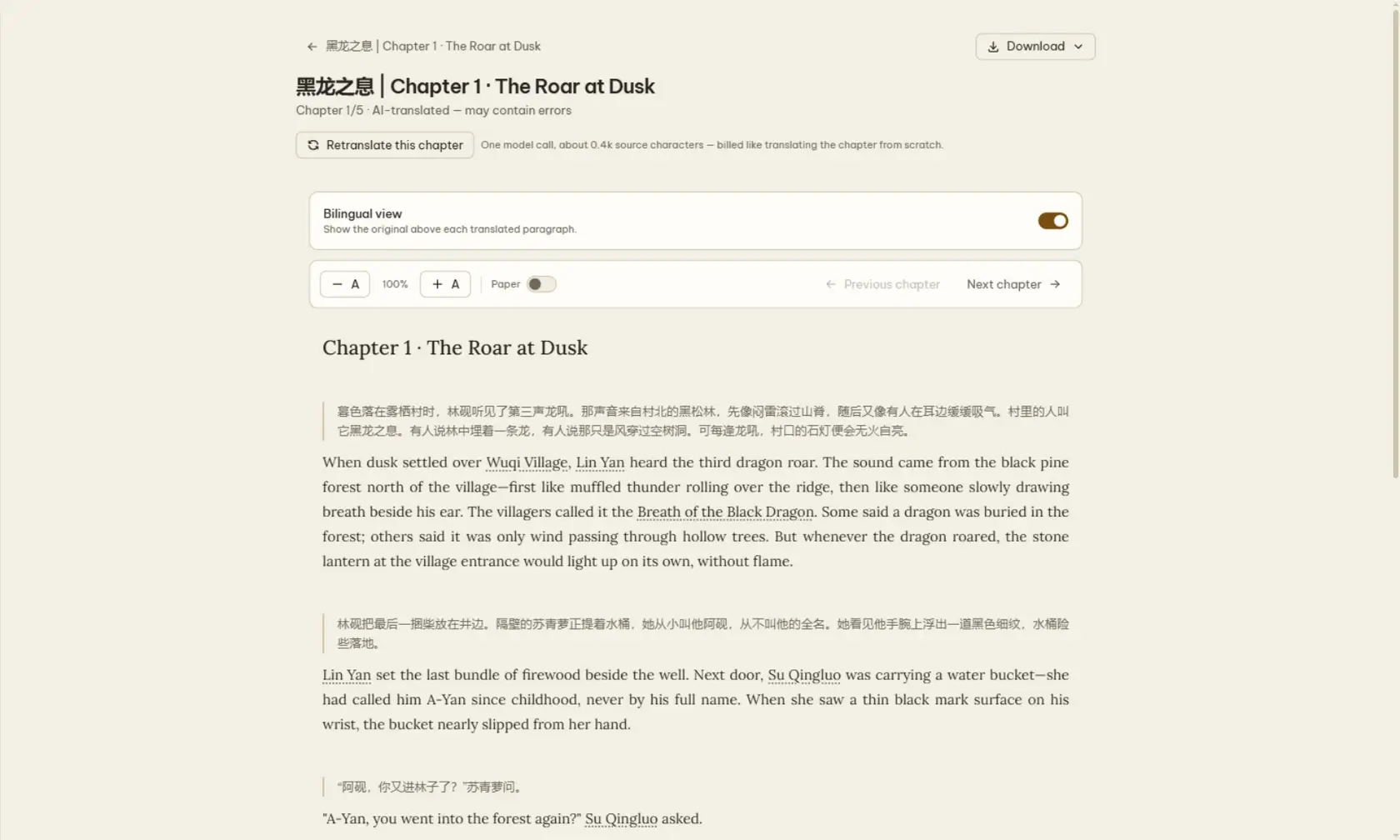
I open the run just translated and check it before pressing on.
- New names that appeared, are they genuinely new people, or old people written differently?
- Did speaker and listener change how they address each other, compared with the table?
- Was a source passage dropped, or left standing in the source language?
A wrong name or a wrong form of address: fix the table, then retranslate the affected part. When you do not know where the fault is, find untranslated or odd lines first; handle a missing passage or another defect at that spot. Fixing the table does not fix old translations by itself.
When this step is done I have one checked run, and a table newer than the one I started with.
Three places the name table cannot save you
Poetry. The machine can land the literal meaning of every word and still lose the subtext, the relationship, or the feeling in a line of verse. A poem inside a novel usually states a relationship, not an event. When the translation is done and only the event is left, that line is broken.
Irony. Some lines use honorifics to cut someone down. Translating them into neutral politeness deletes the barb. I only catch those reading aloud. I never catch them staring at a table.
Dropped passages. When a run stops in the middle of a chapter, what follows is not a bad translation. It is an untranslated part. A passage dropped entirely is harder: it leaves no source sentence behind, so scanning for untranslated text will fool you. I count a chapter as done only after two gates: reading through it with no source-language sentence left standing, and opening the source at the same end-of-chapter junction to confirm that no passage was dropped entirely. For a full look at what automated checks catch and the four blind spots that still require human review, see How good is AI novel translation, and what still needs a quick check?.
I do these five things with the novel I am reading, on my own file, and I start from the NovelVerba translator.