Build a character name table before translating a novel with AI
Tri Thu知秋
· Updated
On this page
In the first forty chapters, the main character's name shows up three ways: Lin Feng in chapter 1, Feng Lin by chapter 17, and by chapter 40 his friends are calling him Ah Feng. Follow it that far, and it is easy to believe he has a little brother somewhere.

Believed it enough that for several chapters I sat waiting for this Ah Feng to get his own storyline, thinking the novel had just added family for the main character. I was about to write a line into my name table: Ah Feng, Lin Feng's younger brother. Halfway through the line I went back to chapter 1, and there it was, plain: Ah Feng is Lin Feng himself. 阿峰, the way his friends say his name with warmth. The machine kept the characters and handed me a stranger.
One person, three names. I nearly added a mouth to that family.
Find and replace dies three deaths
Before the table, I took the shortest road: find and replace. It died three deaths.
One, the characters of a name stand in other places too. The "Lin" of Lin Feng is also the "Lin" of the Lin family, of plenty of other people in the novel. Replace character by character and a whole clan changes name along with him.
Two, a nickname does not contain the main name. "Ah Feng" holds no "Lin" anywhere. The search could run until dawn and never meet it.
Three, some translation turned the name into a different word entirely. An old convert I once read rendered 林峰 as "Forest Peak", character by character. Search by the man's name and you will never meet a mountain.
One person, one row
So I dropped find and replace and built a table for exactly one person. No need for ten characters at once, the hardest one goes first:
| As written in the translation | Original | Where it appears | What it actually is | What I settled on |
|---|---|---|---|---|
| Lin Feng | 林峰 | chapter 1 | the main name | keep it, the whole set |
| Feng Lin | 林峰 | chapter 17 | the machine flipped the name to Western order | merge into Lin Feng |
| Ah Feng | 阿峰 | chapter 40 | what his friends call him | keep Ah Feng, note: still Lin Feng |
The last column is the decision, and it gets made once. The main name gets exactly one spelling, and the machine's favorite variants all merge into it. The nickname stays, because that is how people inside the novel talk to each other, and keeping it keeps the dialogue warm. Every spot just has to know who he is.
"Merging" here means I recognized that several spellings were one person, then settled one official spelling for the whole novel. It does not mean deleting those rows. Each source entry keeps its own row in the name table, with the note "still Lin Feng", so the next scan catches it and translates it the settled way. The table remembers the people for me, so I do not have to memorize the table.
Matching characters do not always mean the same person
The running example of this article cuts one way: Lin Feng, Feng Lin and Ah Feng look like three names, and they are one man. The opposite trap is just as real: two names that share the family character 林 do not have to be the same person. Suppose the novel also holds a Lin Hao (林浩): he and Lin Feng (林峰) share that character and remain two different people. Judge along the wrong axis and things break in two opposite ways: you lose a person, or you merge two people who are not the same.
When I review the name table, I ask two different questions. Are these different spellings one person? If so, I choose a main name, keep the nickname, and note the connection on each source entry. Or do two different people happen to share part of a name, like Lin Feng and Lin Hao? Then I keep them separate and read the scene to work out who is present and who is being addressed. These are reading decisions, not two kinds of rows or a merge button in the app.
| Situation | Example | One person? | What I do |
|---|---|---|---|
| Many spellings, one person | Lin Feng, Feng Lin, Ah Feng | Yes | settle one main spelling, keep the nickname, note it on each source entry |
| Two names share 林 | Lin Feng (林峰) and Lin Hao (林浩), a hypothetical example | Not just because they share a surname | keep them separate; check the scene and who is being addressed |
| The same nickname twice | two characters in the novel who are both called by one nickname | Depends on the scene | don't guess; follow the scene: who shows up, who is speaking |
Gather the people first, translate after
The gathering stands before the translation pass, not after it. In the first ten chapters, I collect every spelling that has appeared and ask one question: which of these are the same person. Only once that is answered does the machine get to keep translating.
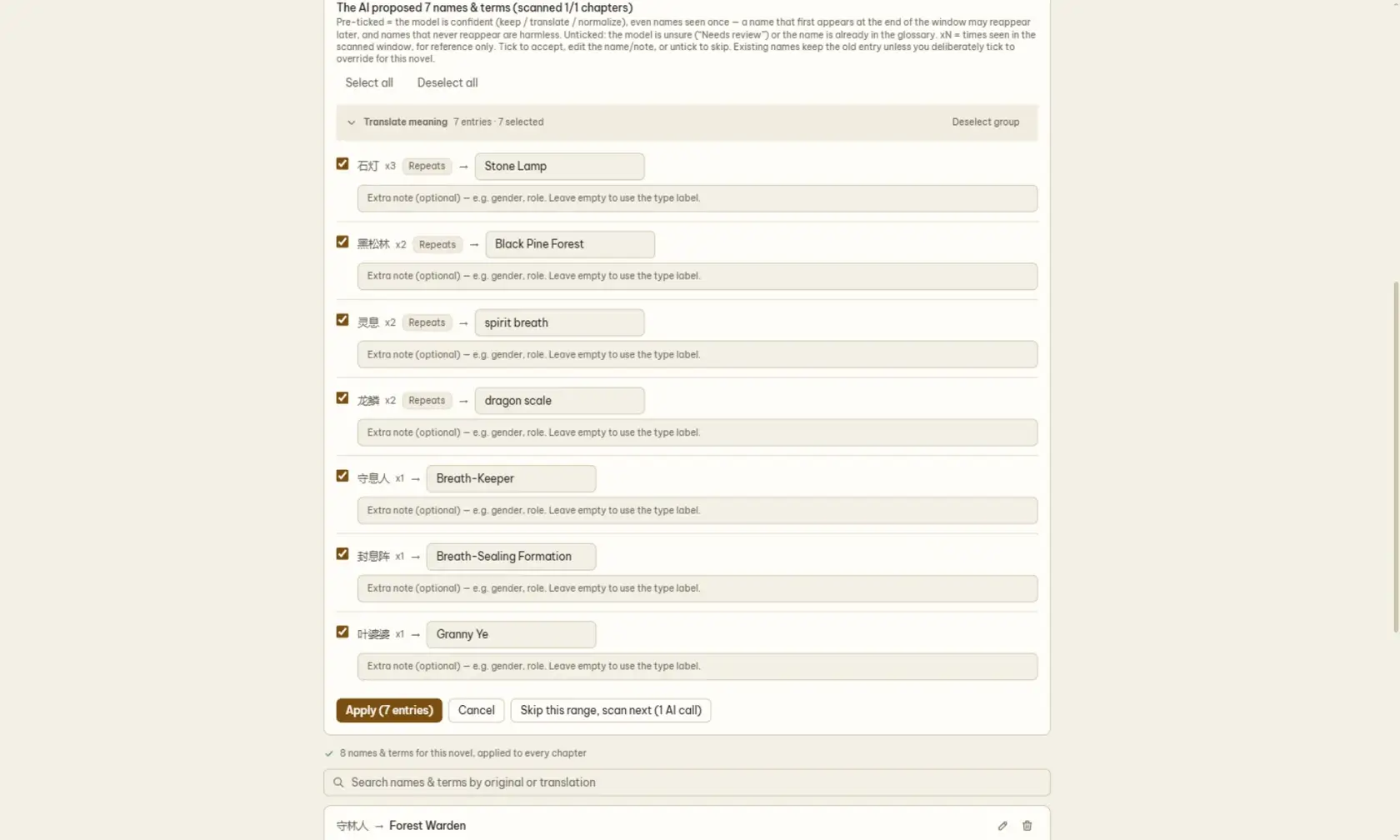
I do that part in NovelVerba. It scans names across a chapter range I choose, reading at most ten chapters per pass, then splits the proposals into four groups to review: Keep as-is, Translate meaning, Normalize, Needs review. My job shrinks to deciding which clusters are one person and settling one spelling. What I settle carries into every later translation pass by itself, no pasting paragraphs twice.
Changing your mind halfway through the novel, don't. Once the table is saved, it only applies to chapters translated after that point. Chapters already translated keep the old names. To update them, you retranslate the lines involved or the whole chapter when many spots need fixing. Settle early, settle once, then hold the line.
The table is not a god
It can lock the name, it cannot lock every character inside a sentence. A lone Feng standing in the middle of a line of dialogue may simply be wind, 峰 is peak and 风 is wind, and pinyin writes both as feng. The shorter the name, the easier it collides with an ordinary word, so I do not sweep every short name into the table. I look at where it tends to stand: a real name sits next to words of address, an ordinary word sits in the middle of the sentence. The ones that are surely names get settled, the ones that only look alike get let go. Strike every two-character name from the table and Lin Feng is caught in the net anyway, 林峰 is two characters too, and it is the name that runs through this whole novel.
The table also only knows what it has read. A name that enters the story at chapter one hundred means nothing to a scan of the first ten chapters. Tap to scan the next range and the table fills on its own. What is settled stays, new people get their own rows. A name table is a thing that lives with the novel, not something you settle once and walk away from.
The table handles one person becoming three. Who calls whom what, the "Senior Brother" and "little brat" flattened into a flat "you", that is forms of address, and I tell that story in the article on settling address pair by pair. If you want the whole road from the original file to the finished translation, the complete process sits in the overview article.
I did all of the above with the novel I was reading, on my own file, and I started from the NovelVerba web novel translation page.